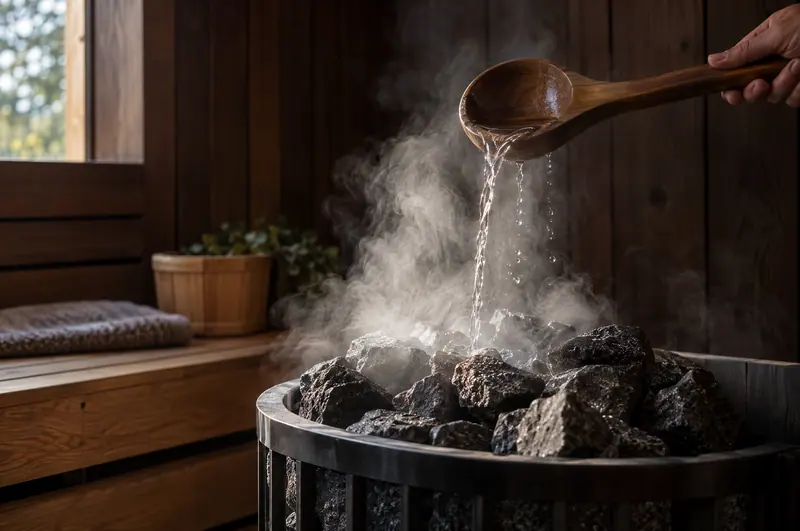
What the heater makers say about sauna temperature: the range they recommend, what the controls allow, how long it takes to heat up, and why a sauna might not get hot enough.
Short answer: two heater makers’ manuals put a traditional sauna at roughly 60 to 80°C. Harvia’s manual for one of its electric heaters says a suitable temperature is about 65 to 75°C, and Narvi’s recommends 60 to 80°C. Controllers go much higher, to 110°C or more, and an infrared sauna runs cooler, at about 60°C. Harvia’s own support pages say there’s no right or wrong temperature, because people’s preferences differ.
This page is about the equipment: what the makers recommend, what the controls allow and how the heat behaves. It isn’t health or medical advice; for that, speak to a doctor.
What temperature should a sauna be?
| Type of sauna | Temperature | Who says so |
|---|---|---|
| Traditional sauna, electric heater | 65–75°C (149–167°F) “suitable” | Harvia, Cilindro Pro manual |
| Traditional sauna, electric heater | 60–80°C (140–176°F) “recommended” | Narvi, Velvet manual |
| Traditional sauna, hot | 80–100°C (176–212°F): the air may feel dry even with water on the stones | Harvia support |
| Traditional sauna, mild | 50–60°C (122–140°F): plenty of water can be used on the stones | Harvia support |
| Infrared sauna | About 60°C (140°F) | Harvia |
| Outdoor infrared sauna (Polar Eclipse) | 40–65°C (104–149°F) range, as listed | Polar Recovery’s product pages |
| Steam room | 45–50°C (113–122°F) | Harvia |
So the answer to “how hot should a sauna be” depends on the kind of sauna and on taste. A traditional sauna is the hot, dry one, and the heat is adjusted with the thermostat and with water on the stones. An infrared sauna uses heating panels and runs at a lower air temperature. A steam room is cooler again but very humid: see sauna vs steam room.
Sources: Harvia: Cilindro Pro electric sauna heater, instructions for installation and use (PDF hosted by zoechling-holz.at); Narvi: Velvet electric sauna heater with Flow controller, installation and instruction manual (EN section); Harvia Support: What is the correct sauna temperature?; Harvia: Hop on the Wave of Infrared Waves; Harvia: How to build a steam room. Checked 30 September 2026.
Sauna temperature in Celsius and Fahrenheit
The figures on this page are in Celsius. If you’re reading American sources, these are the same temperatures in Fahrenheit:
| Celsius | Fahrenheit |
|---|---|
| 40°C | 104°F |
| 50°C | 122°F |
| 60°C | 140°F |
| 65°C | 149°F |
| 70°C | 158°F |
| 75°C | 167°F |
| 80°C | 176°F |
| 90°C | 194°F |
| 100°C | 212°F |
| 110°C | 230°F |
How high the controls go
The recommended range sits well inside what the controls allow. The US edition of HUUM’s UKU controller manual says the temperature can be set between 40 and 110°C, and Narvi’s Velvet electric heater gives an adjustable range of 40 to 115°C. Wikipedia’s history of the Finnish sauna says air temperatures averaged around 75 to 100°C and sometimes exceeded 110°C.
Above that there’s a safety cut-out. Harvia says the temperature sensor also acts as an overheat protector if something fails. The same HUUM manual gives 130°C as the point at which its overheating protection applies, after which the sauna must be inspected, and Narvi lists its overheat protector at 144°C. Harvia says the cause of overheating must be found and fixed before the protector is reset.
Sources: HUUM: UKU 4.1 (Wi-Fi/Local) sauna control system user manual, US edition (PDF); Narvi: Velvet electric sauna heater with Flow controller, installation and instruction manual (EN section, technical data); Wikipedia: Sauna (encyclopedia, not a manufacturer source); Harvia Support: Temperature sensor installation; Harvia: Cilindro Pro electric sauna heater, instructions for installation and use (PDF hosted by zoechling-holz.at). Checked 30 September 2026.
Temperature and humidity: why water changes how it feels
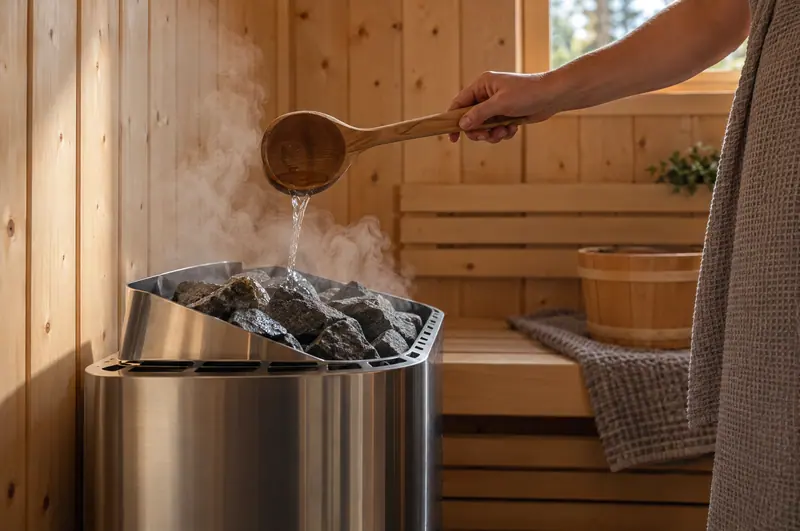
The thermostat is only half of it. Harvia says the air in a sauna becomes dry as it warms, so water is thrown on the hot stones to bring the humidity to a suitable level. That’s why the same sauna can feel quite different at the same reading.
What the makers say about the water:
- A little at a time. Harvia says the ladle should hold no more than 0.2 litres: pour too much and only part of it evaporates, and the rest can splash as boiling water. HUUM recommends about 80 ml at a time.
- Clean water only. Harvia says the water should be of clean household quality, and that only aromas made for sauna water may be added. Narvi says not to use sea water or other salty water.
- Heat and humidity trade off. On Harvia’s Combi heaters, which have a built-in steamer, the controller caps the two together: the temperature in °C and the humidity percentage can’t add up to more than 140. A setting of 60°C and 80% humidity, for example, adds up to exactly 140.
Sources: Harvia: Cilindro Pro electric sauna heater, instructions for installation and use (PDF hosted by zoechling-holz.at); HUUM: DROP electric sauna heater user manual, EU edition (PDF); Narvi: NC 16, 20, 20 VS and 24 wood-burning sauna stove manual (EN section); Harvia Support: Air humidity and temperature settings in Combi heaters. Checked 30 September 2026.
How long does a sauna take to heat up?
Harvia and HUUM both say about an hour: a properly insulated sauna with a heater of the right size takes around an hour to reach bathing temperature. Retailers often quote faster times for their own models. These are the retailers’ claims as we recorded them from their listings, for saunas sold with a heater. They aren’t our measurements:
| Model | Heat | Heat-up claim (as listed) |
|---|---|---|
| CenturaHeat 2 Person Steam Outdoor Sauna HouseCenturaHeat | Electric | About 15 minutes to heat up to 50 degrees Celsius, and about 30 minutes to heat up to 70 degrees Celsius |
| Gardj Garden Sauna QUADRO 180 cm with Electric StoveGardj | Electric | 80 °C in 30–40 minutes |
| Gardj Outdoor Barrel Sauna 180 cm with Wood-Burning StoveGardj | Wood-fired | 80 °C in 30 minutes; 95 °C in 1 hour |
| Gardj Garden Sauna QUADRO 180 cm with Wood-Burning StoveGardj | Wood-fired | ~80 °C in 30 min, ~95 °C in 60 min |
| Gardj Outdoor Barrel Sauna 240 cm with Electric StoveGardj | Electric | ~80 °C in 35–45 min |
| CenturaHeat 4-6 Person Outdoor Wood Barrel Steam SaunaCenturaHeat | Electric | About 15 minutes to heat up to 50 degrees Celsius, and about 30 minutes to heat up to 70 degrees Celsius (at 10°C external temperature) |
| Gardj Outdoor Barrel Sauna 240 cm with Wood-Burning StoveGardj | Wood-fired | 80 °C in ~40 minutes; 95 °C in ~70 minutes |
| Gardj Garden Sauna QUADRO 240 cm with Electric StoveGardj | Electric | ~30–40 minutes to 80 °C |
| Gardj Garden Sauna QUADRO QL 240 cm with Electric StoveGardj | Electric | 80 °C in ~30–40 minutes |
| CenturaHeat 4 Person White Steam Outdoor SaunaCenturaHeat | Electric | About 30 minutes to heat up to 70 degrees Celsius (at 10°C external temp) |
Claims as we recorded them from each listing; words in quotation marks are the retailer's own. Where a sauna is sold without a heater, the claim depends on the heater you add.
Across the 56 models with a claim in our data, the times quoted run from about 15 minutes to two hours. What a heat-up costs in electricity depends on the heater’s output: try your own figures in the running cost calculator.
Sources: Harvia: Cilindro Pro electric sauna heater, instructions for installation and use (PDF hosted by zoechling-holz.at); HUUM: DROP electric sauna heater user manual, EU edition (PDF). Checked 30 September 2026.
Where the temperature is measured
The reading on the controller is the temperature at the sensor, and the makers are particular about where that goes. The US edition of HUUM’s UKU manual says the sensor must be 15 cm from the ceiling, and not above the heater but 50 cm from its outer edge. Harvia says to keep it away from the door, glass walls and windows, where the air may be cooler, and away from a supply air vent, because air flowing past cools the sensor and gives the heater the wrong reading.
The makers also set the top bench by its distance from the ceiling. Harvia says the gap between the upper bench and the ceiling shouldn’t exceed 1,200 mm, and HUUM gives 1,100 to 1,300 mm.
Sources: HUUM: UKU 4.1 (Wi-Fi/Local) sauna control system user manual, US edition (PDF); Harvia Support: Temperature sensor installation; Harvia: Cilindro Pro HPCE2642 EN - Instructions for installation and use of electric sauna heater (PDF hosted by Zöchling Holz); HUUM: DROP electric heater user manual (EU, 2025). Checked 30 September 2026.
Why a sauna won’t get hot enough
If a sauna is slow to heat, these are the points Harvia’s Cilindro Pro manual and support pages connect with heating:
- The heater’s output. Harvia’s rule is about 1 kW for each cubic metre, and glass, stone and uninsulated log walls all add to the room size you should count. Check yours with the heater size calculator.
- Insulation. Harvia’s one-hour heat-up figure is for a properly insulated room, and it says a sauna must be insulated carefully so the heater output can stay moderately low.
- The stones. Harvia says stones piled too tightly, stones that have settled, or the wrong type of stone can block the air flow through the heater and cut its heating power. It says stones should be restacked from time to time and, in a sauna used about twice a week, changed once a year. HUUM says to replace all the stones after 400 hours of use.
Anything electrical is a job for an electrician, not something to investigate yourself.
Sources: Harvia Support: How do I select the correct heater power?; Harvia: Cilindro Pro electric sauna heater, instructions for installation and use (PDF hosted by zoechling-holz.at); Harvia Support: How often should the heater stones be changed in a family sauna?; HUUM: DROP electric heater user manual (EU, 2025). Checked 30 September 2026.
Infrared sauna temperature
Infrared saunas work at a lower air temperature. Harvia says infrared panels heat the room to approximately 60°C. Polar Recovery lists a range of 40 to 65°C for its Eclipse outdoor infrared saunas, which draw 3.3 to 5.1 kW. An encyclopedia source gives 40 to 60°C for infrared against 70 to 90°C for traditional saunas. See every model on outdoor infrared saunas.
Sources: Harvia: Hop on the Wave of Infrared Waves; Wikipedia: Infrared sauna (encyclopedia, not a manufacturer source). Checked 30 September 2026.
Wood-burning stoves: controlling the heat
With a wood stove, the heat is controlled at the stove itself. On Narvi’s NC stoves the output is set with the ash drawer: closing it gives the lowest output and a longer burn. Narvi also says not to heat the stove continuously for more than three hours, and to avoid firing it so hard that the channels of the stone compartment glow red for a long time, which overloads the firebox and shortens the stove’s life.
Compare stoves on wood-burning sauna stoves, and check the smoke rules for your address with the smoke control area checker.
Sources: Narvi: NC 16, 20, 20 VS and 24 wood-burning sauna stove manual (EN section). Checked 30 September 2026.
Using the heater: timers and safety points
The controls limit how long an electric heater stays on. On Harvia heaters with a mechanical timer, the operating scale runs from 0 to 4 hours; with Harvia’s Xenio control panels the on-time is six hours by default; and the US edition of HUUM’s UKU manual gives a choice of 3 or 6 hours for a private sauna. The Finnish Sauna Society’s fire-safety page says the standard for electric heaters sets a maximum of 12 hours’ continuous use, after which the heater must be allowed to cool.
Fire-safety points from the makers’ manuals:
- Check there’s nothing on, above or near the heater before you switch it on (HUUM).
- Don’t cover the heater: Narvi says it creates a fire hazard.
- Don’t hang clothes to dry in the sauna, because of the risk of fire (Harvia).
- After bathing, Harvia suggests leaving the heater on for about ten minutes to dry the wooden parts.
Always follow the manual for your own heater: figures differ between models.
Sources: Harvia Support: Quick heater instructions for models with mechanical controls; Harvia Support: Xenio - Changing the on-time of the heater; HUUM: UKU 4.1 (Wi-Fi/Local) sauna control system user manual, US edition (PDF); Finnish Sauna Society: Fire safety in the sauna; HUUM: DROP electric sauna heater user manual, EU edition (PDF); Narvi: Velvet electric sauna heater with Flow controller, installation and instruction manual (EN section); Harvia: Cilindro Pro electric sauna heater, instructions for installation and use (PDF hosted by zoechling-holz.at); Harvia Support: Maintaining your sauna. Checked 30 September 2026.