What a session costs at the Ofgem price cap of 26.32p per kWh (1 October to 31 December 2026). Change any number to match your sauna.
Short answer: on our assumptions, most electric garden saunas cost £1.48 to £2.96 a session at the current price cap, including the heat-up. A small infrared sauna costs about £0.66. Work out yours:
kWh = kW × (heat-up ÷ 60 + session ÷ 60 × % on). Default price: Ofgem cap, 1 October to 31 December 2026.
Calculator by outdoorsauna.uk, using UK prices checked 30 September 2026. A guide only, not professional advice: important information.
Pick a starting point from the list, then change any number to match your sauna and your habits. The default electricity price is the Ofgem price cap unit rate for Direct Debit customers, 26.32p per kWh, which applies from 1 October to 31 December 2026. That’s an average for Great Britain: rates vary by region, and the cap doesn’t apply in Northern Ireland. If you’re on a fixed deal, or in Northern Ireland, use the unit rate on your bill.
What a session costs at the current price cap
On our default assumptions, an 8 kW electric sauna costs about £2.63 a session, or about £274 a year if you use it twice a week. The table shows the common heater sizes:
| Heater | Energy per session | Per session | 2 a week, per year | 4 a week, per year |
|---|---|---|---|---|
| Infrared cabin, 2.5 kW | 2.5 kWh | £0.66 | £68 | £137 |
| Electric, 4.5 kW | 5.6 kWh | £1.48 | £154 | £308 |
| Electric, 6 kW | 7.5 kWh | £1.97 | £205 | £411 |
| Electric, 8 kW | 10.0 kWh | £2.63 | £274 | £547 |
| Electric, 9 kW | 11.2 kWh | £2.96 | £308 | £616 |
| Electric, 10.5 kW | 13.1 kWh | £3.45 | £359 | £719 |
| Electric, 12 kW | 15.0 kWh | £3.95 | £411 | £821 |
How the calculation works
A sauna heater uses its full power while it heats the room, then switches on and off on its thermostat to hold the temperature. So we split a session into two parts:
- Heat-up: the heater runs flat out. Default 45 minutes for a traditional sauna, 15 minutes for infrared.
- Session: the heater cycles to hold the temperature. Default 60 minutes, with the heater on 50% of the time.
Energy (kWh) = heater kW × (heat-up hours + session hours × share of time on). Cost = kWh × your unit rate.
The 50% figure is our assumption, not a measurement: a well-insulated sauna on a mild day will cycle less, and a glass-fronted one on a frosty night more. Heat-up time depends on the heater, the room and the weather; retailers’ own claims range from about 15 minutes to 2 hours (see the claims on our barrel saunas page). Change both in the calculator to see how much they matter.
The standing charge (54.83p a day under the current cap) is left out, because you pay it whether or not you have a sauna. The cap figures include no VAT: the government has removed VAT from domestic electricity from 1 October 2026 to 31 March 2027.
Sources: Ofgem: Get energy price cap standing charges and unit rates by region. Checked 30 September 2026.
Infrared vs traditional running costs
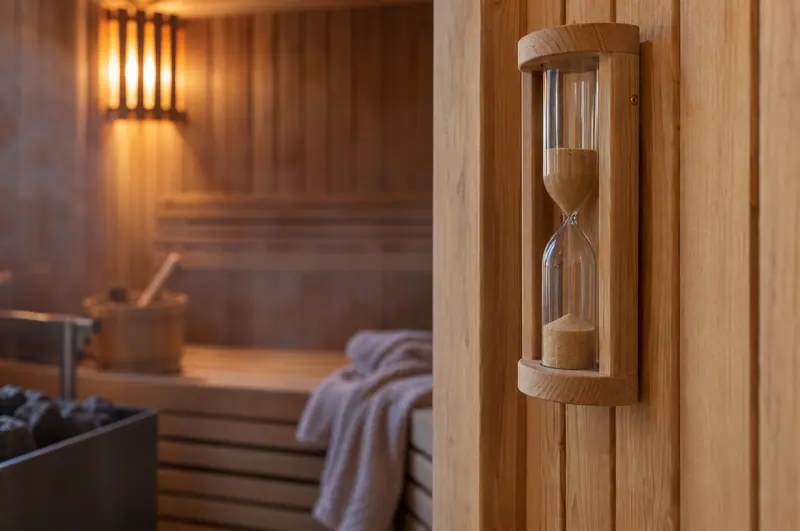
Infrared saunas are cheaper to run for two reasons: the panels draw less power (2 kW to 5 kW for most outdoor models, against 6 kW to 9 kW for a typical traditional heater) and they need only a short warm-up because they don’t heat the air as much. On our assumptions, a 2.5 kW infrared session costs about £0.66, against £2.63 for an 8 kW traditional sauna.
Hybrids, with both infrared panels and a traditional heater, can draw much more if you run both at once. See outdoor infrared saunas for each model’s stated power.
Bigger heater, bigger bill?
Per hour, yes: a 9 kW heater uses more than a 6 kW one. But the right heater for your room is the one the maker specifies for its volume. A heater that’s too small for the room runs flat out for longer and may never reach temperature. Size it with our heater size calculator, then compare models on Harvia heaters and HUUM heaters.
Ways to spend less
- Shorten the heat-up. Start the heater when you’ll use it. A Wi-Fi controller lets you switch on from the house (see heater controls).
- Keep the door shut and the vents as the maker sets them. Every time the door opens, hot air goes out.
- Fit the right heater. One that’s too small for the room can cost more, not less, because it rarely switches off.
- Go back-to-back. If several people use it, one long session costs less than two short ones with two heat-ups.
- Check your tariff. Some tariffs have cheaper hours; the calculator takes any unit rate.
Wood and gas
A wood-fired sauna uses no electricity to heat, but logs aren’t free. The cost depends on where you buy, how much you store and how dry the wood is, so we don’t estimate it. In England, wood sold in quantities under 2 m³ must be certified Ready to Burn. See wood-fired saunas.
Gas-fired saunas and sauna tents run on bottled propane, and the cost depends on the heater and your gas supplier.
When the price cap changes
Ofgem resets the price cap every three months. The cap for 1 January to 31 March 2027 will be announced on 25 November 2026, and we’ll update the default rate here and the figures across the site when it is. Our UK Sauna Price Index tracks sauna prices on the same quarterly rhythm, and our methodology explains how.
Sources: Ofgem: Energy price cap explained; Ofgem: Changes to energy price cap between 1 October and 31 December 2026. Checked 30 September 2026.
For what the sauna costs to buy, use the garden sauna cost calculator, read how much a garden sauna costs, or browse every garden sauna by price.
Embed this calculator
Free to use on your own site, with a credit link: