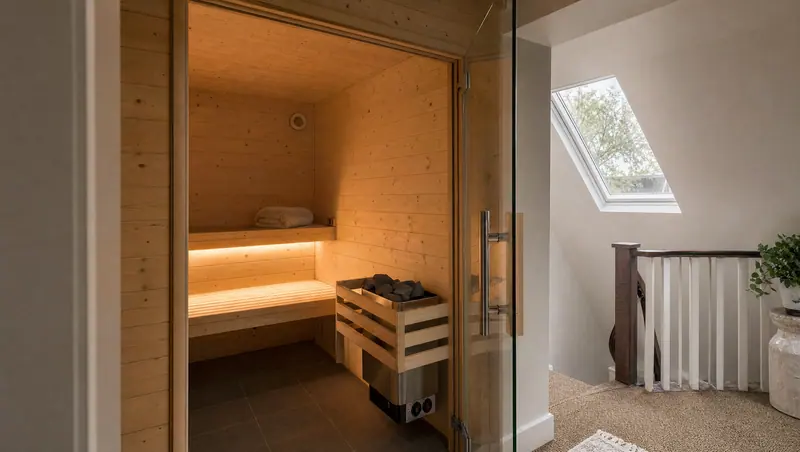
How a sauna inside your home compares with one in the garden: the space, the building work, the electrics, the rules and the cost.
Short answer: you can have a sauna inside your home or in the garden, and the big difference is where the heat and moisture go. Indoors, you’re building a hot, humid room inside the house, so it needs the insulation, moisture barrier and ventilation the heater’s maker specifies, and a heater on its own circuit; a few small infrared cabins plug into a socket instead. In the garden, the sauna is its own building: you need space, a base, a cable run and a check against the planning rules, but the heat and steam stay outside.
Indoor or garden: the differences
| Indoor sauna | Garden sauna | |
|---|---|---|
| Space | A spare room, bathroom, loft or garage corner with enough headroom: heater makers give minimum room heights from about 1.9 m | A level spot outside; the median garden sauna in our data takes up 5.5 m² |
| Building work | Insulation, a foil vapour barrier, timber panelling and vents, built to the heater maker’s manual; or a ready-made indoor cabin | A kit assembled on a base; most arrive flat-packed |
| Electrics | A traditional heater needs its own circuit, and the room becomes a “special location” under Part P in England. Some small infrared cabins plug in | A new circuit from the house, which is notifiable work in England; wood-fired saunas need no supply |
| Moisture | Has to be managed inside the house, with the ventilation the maker specifies | Vents to the open air |
| Planning | The outbuilding rules don’t apply, but check your lease or deeds, and ask the council before altering a listed building | Permitted development limits apply: check them here |
| Heat sources | Electric heater or infrared panels | Electric, wood, gas or infrared |
| Price | Indoor infrared cabins in our sample: £1,499 to £3,500 | Garden saunas from £795; median £6,295 |
An indoor sauna: what the heater makers ask for
A traditional sauna room inside the house is built around its heater, and the heater’s installation manual sets the rules. From the manuals of Harvia, HUUM and Narvi:
- Height. Harvia says a sauna is usually 2,100 mm to 2,300 mm high, and that the minimum depends on the heater; HUUM gives 1,900 mm as the minimum for its DROP, and Narvi 1,900 mm to 2,100 mm for its Velvet heaters.
- Insulation and a vapour barrier. Harvia’s manual specifies 50 mm to 100 mm of insulation, moisture protection such as aluminium paper behind the panelling with the seams taped, a ventilation gap of about 10 mm, and 12 mm to 16 mm panel board. HUUM’s manual describes 50 mm to 100 mm of insulation with a vapour-barrier foil and 12 mm to 16 mm lining board, and Narvi recommends a vapour barrier such as aluminium paper.
- Ventilation. Harvia and HUUM say the air should change six times an hour; Narvi says three to six. Where the vents go depends on the heater and on whether the ventilation is natural or mechanical, so follow your heater’s manual.
- Safety distances. Every heater has minimum distances to walls, ceiling and benches. Harvia says they’re given on the rating plate and in the installation instructions, and must be kept to avoid fires. HUUM recommends a railing around the heater.
- The floor. Harvia recommends ceramic tiles with dark grout, as stones and water can stain other floors; Narvi says the floor under the heater should be fireproof.
- Moisture and drying. Harvia warns that excessive moisture can damage electrical equipment, and says the sauna can be dried after use by leaving the door open.
- The electrician. Harvia, HUUM and Narvi all say the heater must be connected by a qualified electrician.
We haven’t found official UK guidance on moisture from an indoor sauna, or on whether building one needs building regulations approval beyond the electrics. If you’re altering the structure, a floor or a loft, ask your council’s building control team before you start.
Sources: Harvia: Cilindro Pro HPCE2642 EN - Instructions for installation and use of electric sauna heater (PDF hosted by Zöchling Holz); HUUM: DROP electric sauna heater user manual (EU, 2025); Narvi: Installation and instruction manual, Narvi Velvet Electric 9.0 kW / 10.5 kW; Harvia Support: How much space does the heater require around it?; GOV.UK: Approved Document P - Electrical safety, dwellings (2013 edition). Checked 30 September 2026.
Indoor infrared cabins
The quickest way to a sauna indoors is a ready-made infrared cabin: a small timber box with heating panels behind the benches. These are the ones we checked, with the power and supply each retailer states:
| Cabin | Retailer | Size (L × W × H) | Power | Supply | Price |
|---|---|---|---|---|---|
| Professor Health HotBox1 1 Seater Infrared Indoor Sauna 13 AMP | The Range | 1.00 × 0.90 × 1.90 m | 2,000 W | 13 AMP | £1,499 |
| Insignia 1 Person Far Infrared Indoor Sauna | Costco UK | 0.90 × 0.90 × 1.98 m | 1,715 W | 220-240 AC, 50 Hz, 7.2 Amps | £1,599.99 |
| Professor Health HotBox2 2 Seater Infrared Indoor Sauna 13 AMP | The Range | 1.30 × 1.00 × 1.90 m | 2,000 W | 13 AMP | £1,999 |
| Polar Recovery Nova 1 Person Infrared Sauna | Polar Recovery | 0.90 × 0.98 × 1.90 m | 1,600 W | 220-240V AC | £1,999.99 |
| Polar Recovery Nova 2 Person Infrared Sauna | Polar Recovery | 1.20 × 1.00 × 1.90 m | 1,600 W | 220-240V AC | £2,299.99 |
| Nova 4 Person Infrared Sauna | Polar Recovery | 1.80 × 1.20 × 1.90 m | Not stated | 32amp commando socket | £3,499.99 |
Polar Recovery says its one-person Nova plugs straight into a wall socket with no electrician needed, but that it’s for indoor use only, because its wood isn’t treated for outdoor exposure and its electrics aren’t waterproof. Its four-person model lists a 32 A commando socket, which is a dedicated supply. These cabins aren’t designed for the garden: for outdoor-rated ones, see outdoor infrared saunas.
Sources: Polar Recovery: Polar Recovery Nova 1 Person Infrared Sauna; Polar Recovery: Nova 4 Person Infrared Sauna. Checked 30 September 2026.
A garden sauna
A garden sauna keeps the heat, steam and building work out of the house, and gives you the walk across the garden that many people like. We list 489 of them, from £795 for a tent to £44,999 at the top end. The things to plan for:
- Space and height: in England and Wales, within 2 m of a boundary it must be no more than 2.5 m high, base included, to be permitted development (Scotland’s zone is 1 m). The sauna finder shows every model that fits.
- Electrics: a new circuit from the house, by a registered electrician. Our electrical supply calculator shows what a heater draws.
- A base and the delivery route: most arrive flat-packed at the kerb.
- The total cost: the garden sauna cost calculator adds the heater, electrics, assembly and base.
Which suits you?
- Choose indoors if you have a spare room or space with the headroom, you’d rather not walk outside in winter, and you’re happy to build to the heater maker’s specification (or buy an indoor cabin).
- Choose the garden if you have the outdoor space, want a wood-fired or larger sauna, or don’t want heat and moisture inside the house.
- Either way, the heater goes on a circuit that a registered electrician installs and certifies, unless it’s a plug-in cabin whose maker says otherwise.
Sources: Planning Portal: Outbuildings - Planning permission; Welsh Government: Planning permission: outbuildings; mygov.scot: Build a shed, garage or greenhouse. Checked 30 September 2026.